

Hu Bei, Global Times
April 14, 2014
In act one of Shakespeare’s Macbeth, the titular Scottish general hurries back to his castle to tell his wife that the king, Duncan, will soon visit their castle. Lady Macbeth asks, “and when goes hence?” To whichMacbeth replies, “Tomorrow, as he purposes.”
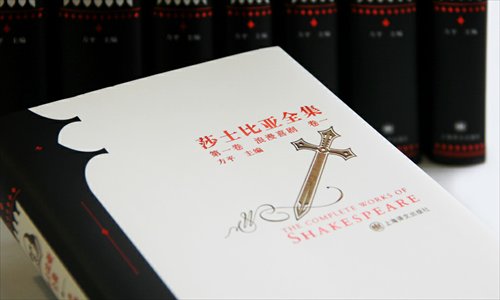
The late Chinese translator, Fang Ping (1921-2008), pondered for a great time over how best to render this four-word response into Chinese. Working in the 1990s, he already had another Chinese version to refer to. This was translated by Zhu Shenghao (1912-1944), one of the first, and to date very few, Chinese translators of Shakespeare’s works. Zhu had translated the line as “Ta dasuan mingtian zou,” which would be the most natural word order to use in modern Putonghua.
However, wishing to preserve as much of the effect of the original blank verse as possible, Fang opted for “Mingtian – Ta dasuan.”
Fang said he chose this method “to keep the original form of Shakespeare’s blank verse, and also, to reveal the general’s implied ulterior motive, of seizing a chance to kill the king.” […continued]
Read Full Story
 0
0 0
0 0
0 0
0
Comments