

Morgan Halvorsen, MD Theatre Guide
April 21, 2014
The Wars of the Roses were a time of extreme turmoil in Britain. In 1399, Henry of Bolingbroke, grandson of Edward III, deposed his cousin Richard II and took the throne for himself as Henry IV, displacing Richard’s heir Mortimer and upsetting quite a few loyal aristocrats. During Henry IV’s reign, his place as king was threatened by no fewer than three major rebellions, two of which are beautifully and devastatingly depicted in the Shakespeare Theatre Company’s productions of William Shakespeare’s Henry IV, Part I and Henry IV, Part II.
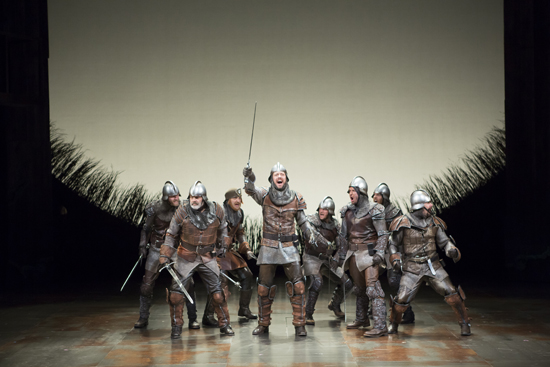
“Uneasy lies the head that wears the crown,” notes Henry IV (Edward Gero) and this is the dominant factor in the events of these plays. In Part I, Henry must contend with the Welsh rebellion of Owen Glendower (Ted van Griethuysen) and his son-in-law, Edmund Mortimer (Aaron Gaines), and the Northumberland rebellion of Mortimer’s brother-in-law, Henry “Hotspur” Percy (John Keabler), who feels slighted on behalf of his father (Kevin McGuire). Nearer to home, Henry’s son and heir, Prince Hal (Matthew Amendt), spends most of his time whoring, drinking, and stealing in the company of degenerates like Sir John Falstaff (Stacy Keach). Things come to a head at the Battle of Shrewsbury, where Hal and Hotspur face off in single combat, Henry IV defeats a Scottish madman (Rhett Henckel), and Falstaff plays dead until he can survive unscathed and claim victory.
Henry IV, Part II follows immediately after the Battle of Shrewsbury and the death of Hotspur. Hotspur’s companions plan for another rebellion; Hal, temporarily redeemed by his heroics at Shrewsbury, is back to his old ways. The dying King Henry fears for the future of his kingdom at the hands of his wayward son. Meanwhile, Falstaff lives off the rumors of his own heroics and attempts to avoid returning to battle under Hal’s brother, John of Lancaster (Patrick Valli). The rebels are routed, but King Henry collapses. Lying near death, he and Hal must reconcile in order to leave the kingdom in good hands.
As the titles suggest, Part I and Part II are really two sections of the same play – a narrative of Henry IV’s reign and the ascension of his son as war hero Henry V. Director Michael Kahn has truly taken this to heart in this production, using the same cast and set for both productions. The benefit of using the same cast is that the character growth from Part I and Part II carries through five hours, in total, of theatre. Both plays begin with the extraordinary, sinister silhouette of Britain, backlit on the far wall of the stage; a telling detail, for it is the fight for England’s future that dominates these plays. […continued]
Read Full Story
 0
0 0
0 0
0 0
0
Comments